The aggressive Victorians have completed their plans and now
are starting the war against NSW.
Some of the Victorian government were unhappy that the attack will be a
surprise and said that the civilised practice is to declare war first. The
Minister of War stared them down and stated. “We will pass the declaration of
war to the Government of NSW when we occupy the NSW Parliament House! Just before they sign the surrender documents.”
NSW defenders are:
Two ray guns and a company of infantry in Sydney Observatory
Two fortress guns – Heavy Artillery in Dawes Point Battery
Two companies of infantry, one squadron of cavalry, one
artillery and one Gatling gun at Hyde Park and Hyde Park Barracks
Two medium artillery guns on Fort Denison
Two medium artillery guns and one company of infantry in
Fort Macquarie.
Victorian attackers are:
Three companies of infantry, Gatling guns and artillery
landed on the east side of the Botanical Gardens.
Four Airships. One armed with two medium artillery and the
others each carrying a company of infantry.
Plans.
Victoria has landed by airship in secret a force on the east
side of the Botanical gardens. Hidden in the darkness they await the appointed
start time. The landers returned to their embarkation point to load up with
Infantry and then go back to Sydney for the assault.
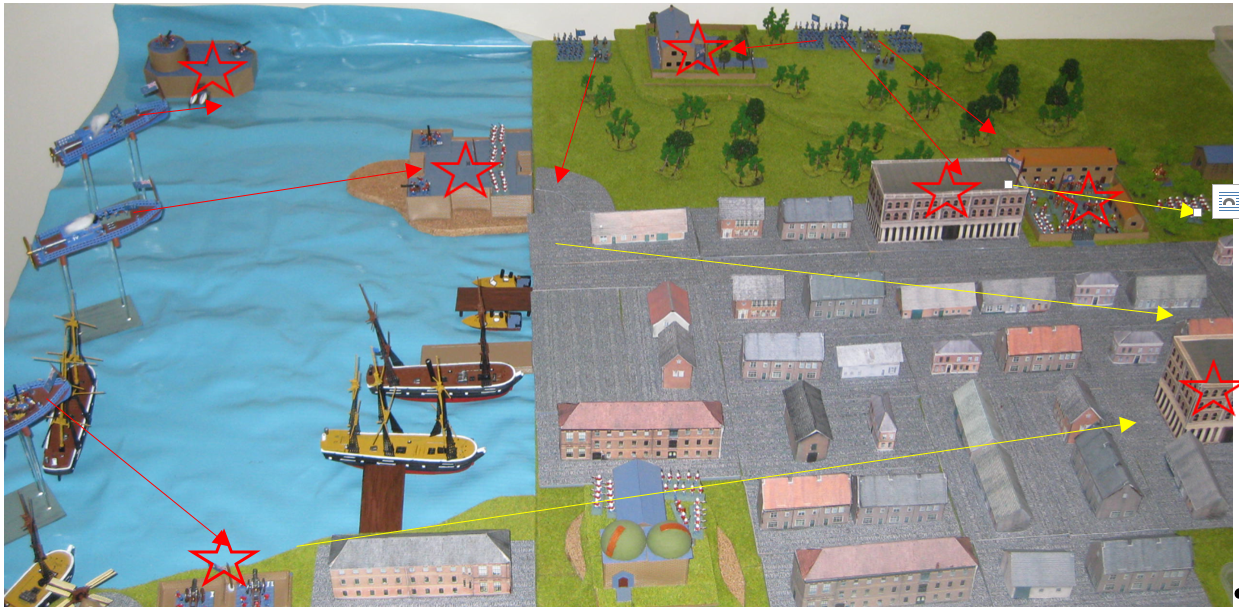 |
| Victoria's plans. Objectives are red stars. Red arrows are the first phase and yellow arrows the second phase. |
The Victorian airship troops will land on Fort Denison, Fort
Macquarie and Dawes point battery and take them by coup-de-main. With these
forts captured the remaining Victorian ships at sea can safely dock a Circular
Quay and land the follow up troops of EMU’s and Cavalry plus additional artillery,
Gatling guns and Infantry replacements.
 |
| The Victorian airships |
The troops landed in the Botanical Gardens will march across
them to capture the Governor General in his home and also the NSW Parliament
building. They will also threaten the Hyde Park Barracks to prevent the troops
there reinforcing their comrades in Fort Macquarie or Dawes point.
 |
| The Victorian troops from the Botanical Gardens |
Once the immediate objectives are secured they will march south and create a line across the city to defend the unloading of the EMU’s and other troops. Hopefully the NSW troops in Hyde Park Barracks will destroy themselves trying to get through the defence line.
As soon as Fort Macquarie and Dawes Point Battery are
captured the airships will return to base for more reinforcements and guns to take
the place of those destroyed in each of the forts. The Fort Denison troops will be transported over
to the city once it is taken and reinforce the assault there. The remaining
gunship airship will stay on patrol over the city to destroy any resistance.
NSW Plans
NSW’s leaders are feeling confident and the troops are not
on high alert. With the announcement of their new ray guns to be made early the
next month they think Victoria has missed its chance to act. To protect their
secret ray guns they have placed a company of infantry there. Victoria is
unaware of this new force and have left them out of their plans.
Fort Denison has two guns facing out to the entrance of the
harbour. Dawes Point Battery has the main guns of the defence but they also
face out towards the entrance. Only Fort Macquarie has the artillery and
infantry available for all round defence. The guns cover the approaches to
Circular Quay.
The main force in the city is in Hyde Park Barracks with
another company of infantry camped in Hyde Park. The NSW army commander is also
there ready to lead.
 |
| NSW troops deployed |
Special Rules.
Victoria will move first but their placement on the board
will be their first move. All NSW troops and guns will start at red reliability and
must use the action points they get each turn (if any) to raise their
reliability to blue – each action point raises reliability by one level. If
during this process they are attacked or use their action points for movement
or fire they can no longer raise their reliability. This means that Victoria
has to strike hard while NSW are still getting their act together.
Turns 1 and 2
As the sun rises in the east the Victorian army moves onto
the board.
NSW starts to wake up.
 |
| The Victorian Armoured Infantry land on Fort Macquarie and assault the defenders |
 |
| Dawes Point Battery under attack. |
 |
| Fort Denison under attack |
 |
| NSW is quickly overwhelmed |
Turn 3
Victorian Turn
At the end of the Victorian turn the Victorian flag flies
over most of their objectives. The Governor General’s Home, Fort Denison, Dawes
Point Battery and NSW Parliament house are all flying the Victorian flag and
under their control. The battle is going well and fighting in Fort Macquarie
should soon be over and the ships waiting at sea can approach and unload the
occupation force.
 |
| NSW Parliament House is occupied and Hyde Park Barracks is attacked. |
NSW Turn
The Victorian Airship is flying down Macquarie Street with
its guns pointing menacingly to each side. The NSW Cavalry squadron moves out
of Hyde Park barracks to go to the assistance of Fort Macquarie. They are then
followed by the infantry company from Hyde Park. The NSW officers and troops
look up in awe at this monstrous machine floating above. They know what it is
but were not expecting one in Sydney. And why is it flying the Victorian
flag!!!!
 |
| Victorian Airship flies down Macquarie Street |
The Captain on the deck of the airship is feeling smug and
secure, knowing that he is in the most powerful vessel in Australia, immune, he
supposes, to any realistic threat. He bellows out orders to his guns to get ready to fire on the NSW troops below.
Just then, from the Sydney Observatory comes two
great coherent light beams that smash into the airship causing mayhem and
destruction. “What the hell was that!” screams the captain, “prepare for
evasive manoeuvres! Get me engineering on the speaker!”
His ship is barely
afloat. Then another two beams of light crash into his ship sending it rocking
but seemingly no more damage is done.
Below the NSW troops tentatively cheer. They hope that
whatever did the damage to the airship is on their side.
 |
| "Target acquired and capacitors at 100% sir!" "Fire!" From Observatory Hill the whole city is visible. |
Turn 4
Victoria
Alas for the Captain of the Victorian Gunship, Engineering
does not respond to his frantic calls (he rolls a one and gets no activation
points), the airship moves forward a half move and remains in line of sight of
the Observatory.
With Dawes Point under their control, the Victorian infantry
urgently heads towards the Observatory while the airship that brought them
there turns and smartly exits the battle, flying low and dodging the many ships in Sydney Harbour it manages to escape the Observatory guns. Soon it is flying safely away to get reinforcements.
Likewise on Fort Denison, the Victorian flag is left flying
and the infantry company re-embark on their airship and head for Circular Quay
to assist with the rest of the battle. Once again with threat of the Ray guns the airship makes good time (it rolled a six for three activation points) and is able to unload on Circular Quay.
In Fort Macquarie, the Armoured Infantry only get one
activation, no doubt caused by the consternation of the Observatory firing, so
they can only fire at the artillery guns and cause some damage.
NSW
The first Ray gun on the Observatory again targets the stricken
airship with two blasts. The first blast hits dead on with potentially 8
damage, but the Victorians make all their saving rolls and the ship just rocks
under the bombardment, its Captain still frantically screaming at engineering.
The second blast also hits dead on with another 8 damage points, despite making
another 7 saves the eighth save fails and the ship crashes to the ground in
flames on Macquarie Street just in front of the NSW cavalry.
The Victorian Generals shake their heads and wonder what else is waiting in store
for them. Only 5 minutes ago everything was going to plan.
Turn 5
The Victorians race towards the Sydney Observatory to knock out the Ray guns.
 |
| The NSW red coats form a perimeter around the Observatory while the Victorians rush from all directions. |
The NSW troops, still unaware that Fort Macquarie has fallen look to go down Pitt Street now that Macquarie Street has been blocked.
 |
| The Victorian airship crashed in Macquarie Street |
Turn 6 and 7
Observatory Hill is surrounded and assaulted from both sides and eventually falls, but not before the crews of the Ray guns have made their escape after destroying their equipment.
 |
| The Victorians assault the Observatory |
NSW are forced to retreat under the relentless Victorian assault and build a final line around the Townhall. Everything else is under the control of the Victorians.
 |
| The final positions. Only the Townhall remains out of Victorian hands. |
So the battle ends.
Will NSW counter attack before the Victorians get their reinforcements ashore? The Victorian Generals hope that there are no more surprises from the NSW army. They set up their command post in the dining room of NSW Parliament house and discuss their next move.


